The Records
The stories wealmost left buried.
The names in this collection have been changed.
The people have not.
Neither have the moments their families witnessed.
A child sleeping through the night for the first time.
A toe moving after paralysis.
A leg lifting days later.
A hand growing strong enough to leave an indentation in a therapy ball.
A brother noticing clearer speech before anyone told him what to listen for.
These are the stories that do not fit neatly into a testimonial carousel. They need room.
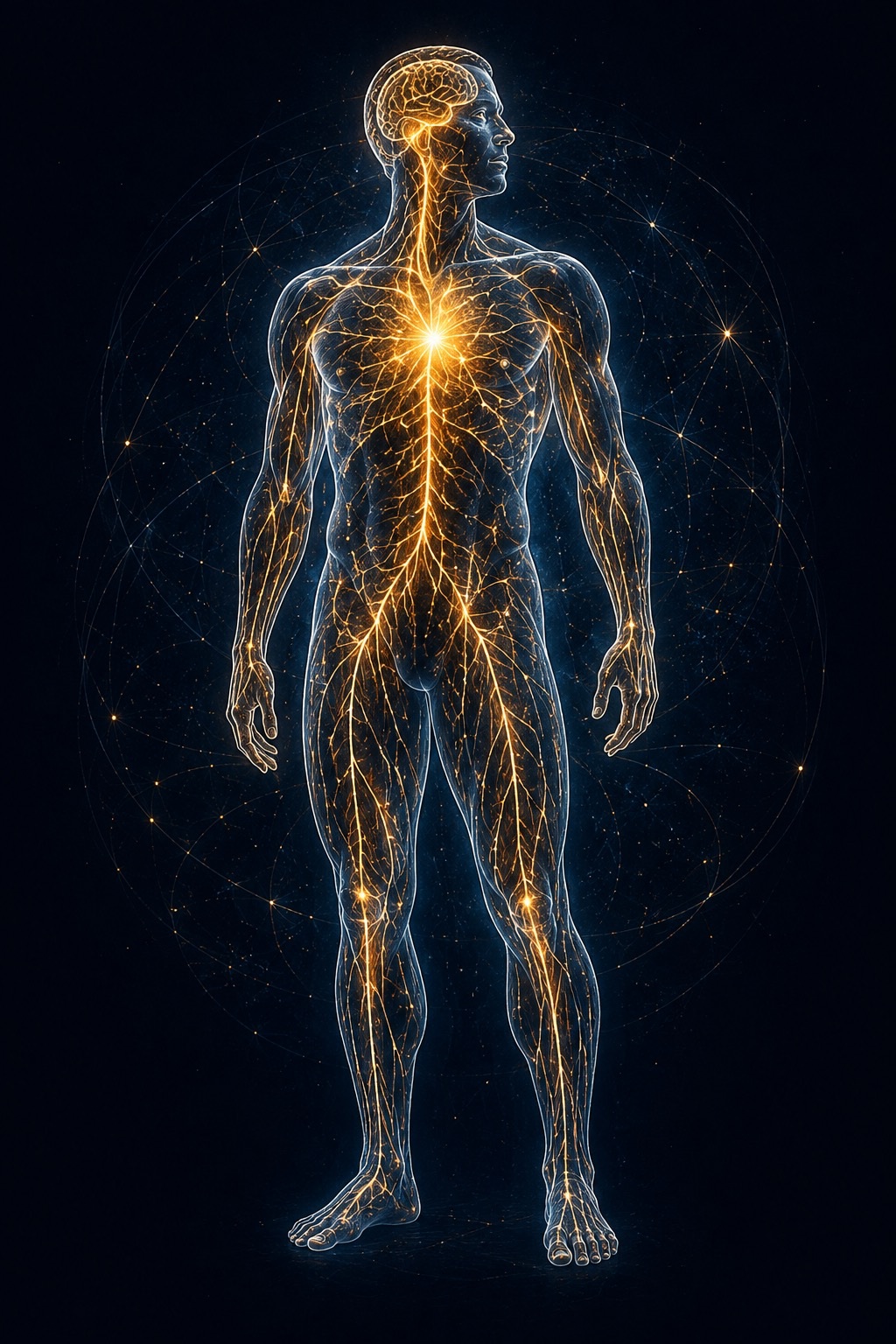
The Founder Record
Two real, unedited BFB Reverse Lookup records from the founder herself, side by side and open to inspection. September 2025 against a record taken this week. Nothing simplified.
Paralysis is rarely one clean absence. It is a landscape of preserved function, blocked routes, partial signals, spasms, pain, intention, compensation, and long stretches when the person gives a command and the body does not answer. That is why the smallest movement can carry the emotional weight of an earthquake. These records should never be collapsed into "mobility improved." Each one is a different road reopening.
The Man Who Felt His Legs Wake Up From the Inside
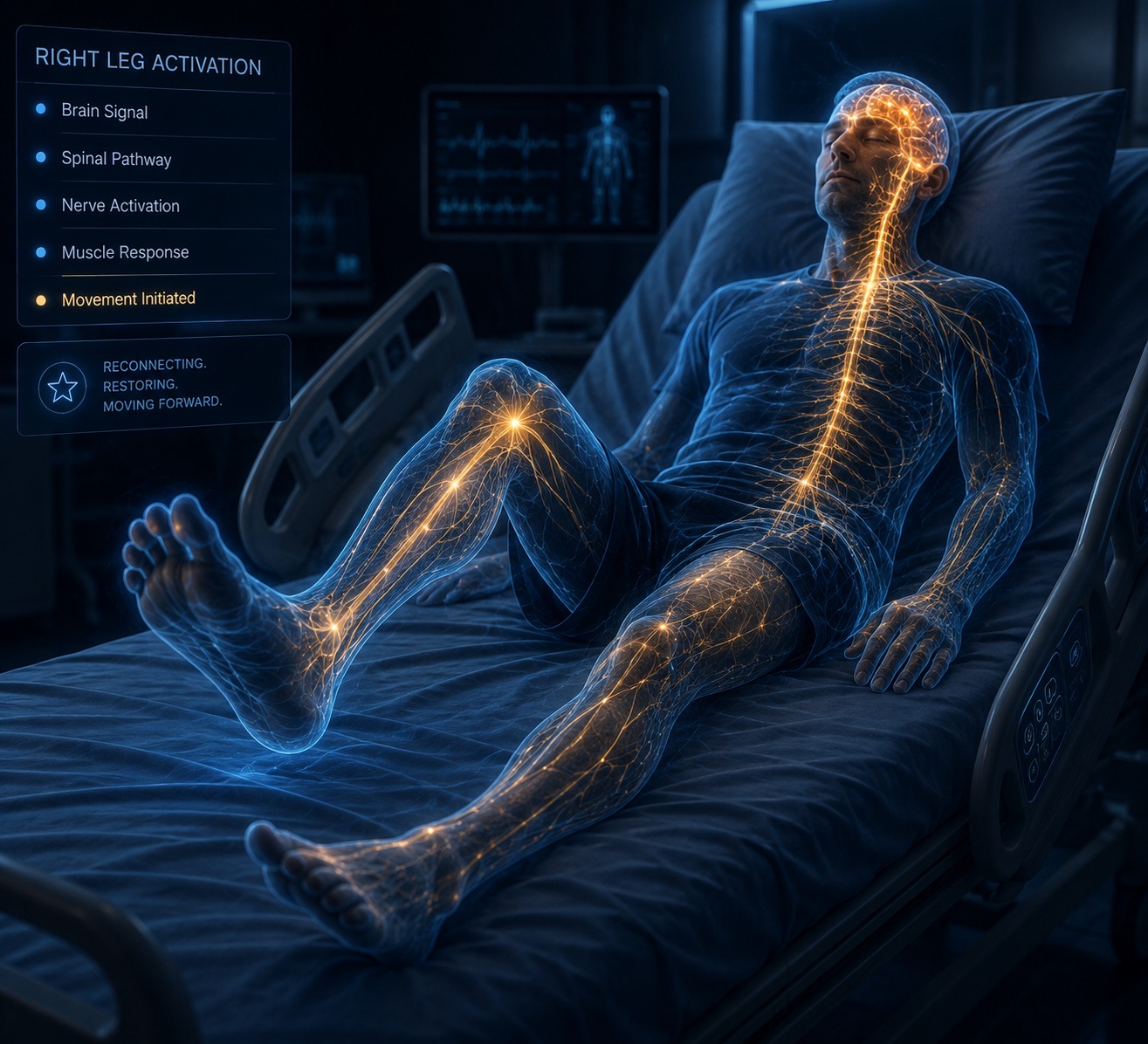
Marcus had been locked inside severe neurological impairment for nearly eighteen years. He used a wheelchair. His legs experienced tremors and abnormal movement, and his body had compensated for so long that even sitting upright could demand effort.
Early in the journey he reported an electrical pulsing sensation in the middle finger of his right hand. He also felt that sitting up was becoming easier. Those were subtle signals.
Later, the changes became harder to ignore. Marcus reported substantially fewer leg tremors after the motor and tremor-routing protocols were introduced.
Then came an event unlike his usual tremors. He described a powerful reverse tremor moving through both legs, strong enough that he felt almost thrown from his wheelchair. During that event his body did something remarkable. He sat extremely tall and straight. One leg lifted. His hands grew stronger, and when he squeezed a therapy ball his grip left a visible indentation.
Then came the toes. All the toes on his right foot moved. The big toe on his left foot moved slowly at first, then produced obvious movement. When he attempted to lift the foot, the foot itself did not rise. But the muscle across the top of the foot visibly flexed.
That is not the finished movement.It is the machinery engaging.
In his standing wheelchair, Marcus began progressing from simply rising onto his toes toward imagining walking and moving his body with the intention of stepping.
The story was not that a paralyzed man suddenly walked. The real story was more intricate and, in its own way, more astonishing: the body began rebuilding the chain of command.
- Sensation
- Posture
- Core recruitment
- Grip
- Toe movement
- Foot-muscle activation
- Motor imagination
Each one a separate light turning ondown a long corridor.
Fewer tremors, improved upright posture, a spontaneous leg lift, stronger grip, voluntary movement in multiple toes, and visible foot-muscle recruitment.
A growing chain between intention, motor planning, and execution.
Marcus was no longer only imagining movement. Parts of his body had begun answering back.
First the Toe. Then the Leg.
Lucas had been living with paralysis and severe structural injury. His body had spent a long time being spoken about in terms of damage, limitation, and what could no longer happen.
Then, fourteen days after beginning the relevant treatment sequence, his toe moved.
A toe movement is easy to dismiss from the outside. To the person inside a paralyzed body it is not small. It means a command travelled. Something crossed the distance between intention and tissue. The nervous system did not complete the whole journey, but it reached the edge.
Four days later, Lucas lifted his leg.
First, the toe answered.Then the leg joined the conversation.
The sequence is what makes the record so striking. First distal movement, then a larger proximal action. Around the same broader treatment period Lucas also reported sleeping deeply and for long periods. He was glad of the rest, because his body had been carrying an enormous repair burden.
Voluntary toe movement appeared, followed four days later by a leg lift.
Evidence that intention could again become movement.
The first movement did not look like walking. It looked like a toe refusing to remain silent.
Lucas later reported that tissue was beginning to grow over an injured area around his femur. That observation is held in the internal chronology because it records what he and his caregivers believed they were witnessing. It requires clinical documentation before it is presented publicly as a tissue-repair claim, and it is not presented as one here.
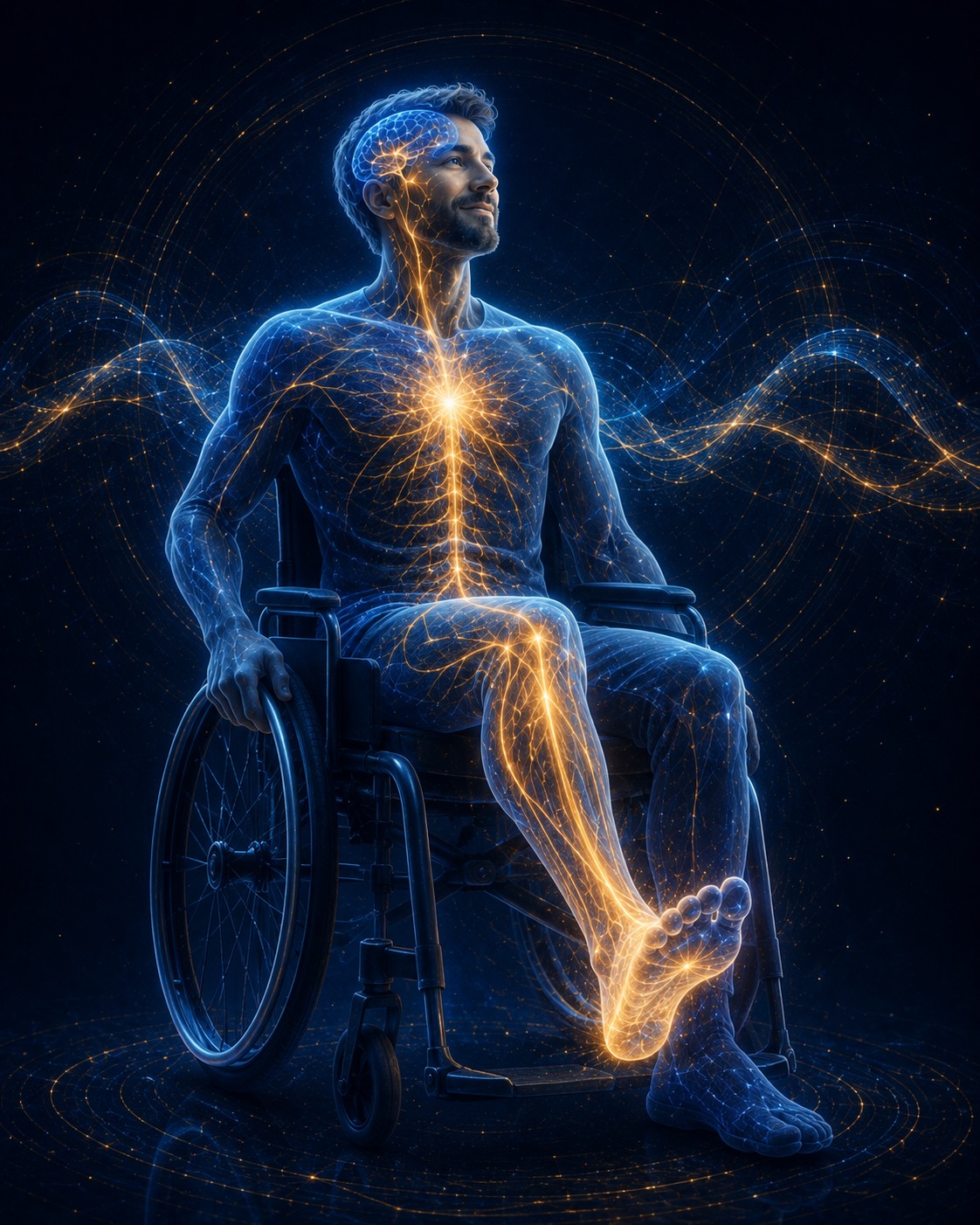
The Brother Who Heard the Difference
Noah's paralysis followed a devastating accident. His family lived close to the details. They knew the baseline of his voice. They knew the way his left arm tightened. They knew how nerve pain could increase the spasticity until the arm became rigid and difficult to manage.
Families of paralysis patients become experts in changes too small for a stranger to detect. A different tone. A fraction more control. An arm that resists less during care. A voice that carries words more clearly.
During a FaceTime conversation, Noah's brother noticed that his speech sounded clearer. He had not been told to evaluate it. No one had prepared him with a target outcome. He simply heard his brother and noticed that the voice coming through the phone was easier to understand.
Around the same time, Noah's caregiver reported that his left arm was significantly calmer and less tight than usual. The arm had a history of substantial spasticity and could lock when nerve pain intensified. That day, it was not fighting with the same force.
Noah also had preserved movement strategies before treatment, including the ability to wiggle through the hips. That matters, because his record is not one of movement appearing from absolute zero. It is a record of an existing motor landscape becoming more organized, less constrained, and potentially more usable.
During later movement trials he did not yet produce toe movement. Arms-overhead positioning appeared to improve his focus, and the team continued studying how hip movement, posture, attention and routing might support future motor attempts.
Not every session produced the hoped-for result.The work included real no-movement trials.That makes the observed changes more credible, not less.
An unprompted family observation of clearer speech, and a caregiver-observed reduction in left-arm tightness and spasticity.
Greater ease in communication, and a calmer limb that had previously locked under pain.
Before a paralyzed body produces a dramatic new movement, it may first become easier to inhabit.

Two bodies, two different roads back toward movement
It would be tempting to combine Marcus and Lucas into one shining paralysis testimonial. That would erase what makes the cases valuable.
Lucas's early sequence was rapid and visible: toe movement, then four days later, a leg lift.
Marcus's sequence was slower and distributed: electrical sensation, easier sitting, fewer tremors, axial extension, grip strength, right-toe movement, left-big-toe movement, foot-muscle recruitment, and movement rehearsal in a standing wheelchair.
One body reopened the route in a short, dramatic staircase. The other rebuilt the route through multiple smaller systems. Both records matter, because paralysis is not one condition and movement does not return in one universal order.
The destination may be movement, but each nervous system chooses a different first doorway.
The people who notice before the charts do
Paralysis records are never only about the patient. They belong partly to the people who lift, turn, dress, position, encourage, clean, wait and watch.
A caregiver knows the normal resistance of an arm. The usual weight of a leg. The sound of strained speech. The exact amount of effort it takes to sit upright.
That is why caregiver feedback is not decorative. It is longitudinal observation. Noah's caregiver noticed his arm was calmer. His brother heard clearer speech. Marcus's movements could be seen and tested. Lucas's toe and leg movements had clear before-and-after meaning because the absence of those movements was already known.
The people closest to the patient become the human measuring instruments between formal evaluations.
The Little Boy Whose Whole Family Finally Slept
Theo began treatment on 31 December 2025. He was eight years old. He had been born prematurely and had experienced low oxygen at birth. His language was still emerging and he was nearly nonverbal. His days could include tics, repetitive finger-licking, emotional outbursts, difficulty cooperating, and the frustration of having more inside him than he could easily communicate.
His nights belonged to the entire family. He did not reliably sleep through them. That meant his parents did not either. Every awakening became a household event. Every difficult night spilled into the next day. The family was not simply managing a developmental challenge. They were living inside an exhausted nervous system together.
Then Theo began sleeping through the night.Not settling a little faster. Not waking one fewer time.Sleeping through the night.
His family reported that the tics stopped. The finger-licking stopped. He became happier, more cooperative, more available to connection.
And something especially tender happened around his new communication cards. Theo was excited about them. A child who had struggled to make himself understood was showing enthusiasm for a new bridge into the world.
His parents began sleeping too. That detail matters, because Theo's story did not happen to one isolated body. When his system settled, the whole house became quieter. The mornings changed. The emotional temperature changed. His parents were no longer beginning each day already depleted.
Sleep consolidated, tics and repetitive finger-licking reportedly stopped, cooperation improved, and communication engagement increased.
Rest, connection, and breathing room for an entire family.
Sometimes a child's first breakthrough is not a dramatic new skill. Sometimes it is the nervous system finally deciding that night is safe.

Read this section as one person. Everything below happened to a single participant, referred to here as Adrian, over one recovery period. It is presented in chapters because the case moved across addiction, liver chemistry, hematology, body mass, medical eligibility and survival trajectory, and no single card could hold that.
The fact that it is one person is the point, not a limitation. Several independent domains moving in the same favourable direction, in the same body, in the same window, is much harder to dismiss as one good day, one subjective impression, or one isolated laboratory swing than the same changes spread across several unconnected people would be.
Adrian was receiving full conventional medical care throughout: steroids, diuretics, lactulose, rifaximin, inpatient care, nutritional support, and alcohol cessation. The original case report claims no single exclusive cause, and neither do we. That honesty does not weaken the record. It gives it bones.
The craving that simply went silent
Through rehabilitation more than once, and relapsing repeatedly. During a hospital admission for severe alcohol-related liver disease he reportedly pleaded not to be sent home, fearing he would drink himself to death. His blood alcohol on admission was documented at 335 mg/dL.
He described the mental drive to drink as simply gone. Not managed. Not argued with. Gone.
Follow-up PEth testing, a blood marker used to detect sustained alcohol consumption, was reported below detection in both November 2025 and February 2026, at values below 10 ng/mL.
The compulsive drive reportedly disappeared, followed by biochemical evidence consistent with sustained abstinence.
Choice.
Hospital history, PEth results, treatment timeline, patient quote.
Please don't send me home
The record can begin with one sentence: "Please don't send me home from the hospital because I'll drink myself to death." Not casually overusing alcohol. Not considering cutting back. Afraid the compulsion would kill him if he left the protection of the hospital.
Months later, his PEth testing was below detection. Twice.
Addiction recovery is not merely one feature of the liver record. It is the hinge on which the rest of it turned.
The man who feared he could not survive outside the hospital later demonstrated sustained biochemical abstinence.
Trust in his own ability to remain alive outside containment.
From bilirubin 23 to 4.8
He entered the hospital visibly and medically ill. Total bilirubin 23.0 mg/dL, a level consistent with severe jaundice and profound liver dysfunction. Then the numbers began moving. Not once. Sequentially.
- 23.0
- 13.8
- 7.3
- 5.2
- 4.8 mg/dL
Albumin also improved from 3.4 to 3.8 g/dL by the December measurement. This was not a subjective feeling. It was a documented downward biochemical slope.
He was receiving conventional medical treatment throughout, including steroids, diuretics, lactulose, rifaximin, inpatient care, nutritional support and alcohol cessation. The record is strongest when all of that is said plainly.
Bilirubin fell from a critically elevated level toward the single digits, and then below five.
A liver trajectory moving in the right direction.
Sequential comprehensive metabolic panels, photographs of jaundice resolution, medication timeline.
His blood counts fell, then rebuilt
His platelet count dropped to 55,000 per microliter. That is not a decorative lab fluctuation. Low platelets can signal serious hematologic instability and increased bleeding risk, particularly in advanced liver disease. Then the count rebounded.
- 55 K/uL
- 102 K/uL
- 104 K/uL
No platelet transfusion was documented in the case record. The rise did not erase the seriousness of his condition, but it showed the trajectory was not fixed in one direction.
Platelets nearly doubled from their nadir and remained above 100 K/uL at the next reported measurement.
Hematologic stability where there had been collapse.
CBC reports, medication and procedure history, physician interpretation. The source treats possible explanations as hypotheses rather than proven mechanism.
Sixty-two pounds left the body
At his July peak he weighed approximately 281.7 pounds. By December his recorded weight was approximately 219.8 pounds. A decrease of about 61.9 pounds.
Some of that change may have reflected reduced ascites and fluid burden. Some may have followed alcohol cessation, diuretic therapy, nutritional changes and reduced inflammatory retention.
Whatever the mixture of causes, his body was no longer carrying the same mass. His abdomen, mobility, breathing, metabolic load and transplant profile were all living inside a different physical reality.
Weight declined by nearly sixty-two pounds from the July peak.
A body with less fluid, less burden, and more medical possibility.
Dated weights, photographs, ascites measurements, medication record. The case record describes the reduction as supportive evidence with several likely contributors.
The door to transplant opened again
He had reached the kind of medical threshold where the language becomes brutal. Advanced liver disease. Very high bilirubin. Alcohol dependence. Ascites. Varices. Thrombocytopenia. Repeated hospitalizations. And, at one stage, transplant ineligibility.
He stopped drinking. His bilirubin fell dramatically. His weight decreased. His platelet count recovered. His overall medical profile improved enough that he was later reported to have become eligible for transplant consideration.
The story is not that he no longer needed medicine. The story is that medicine once again had somewhere to go.
A person who had been considered ineligible was reported to have regained access to transplant evaluation.
An option.
This chapter remains labeled reported transplant-eligibility restoration until the original transplant-center documentation is attached: correspondence, candidacy notes, sobriety requirements, weight record and laboratory trend.
Four systems changed at once
His recovery did not stay inside one organ system. The case produced movement across several independent domains in the same window.
- Alcohol compulsion reportedly disappeared
- PEth testing remained below detection
- Bilirubin fell from 23.0 to 4.8 mg/dL
- Platelets rebounded from 55 to above 100 K/uL
- Weight fell by more than sixty pounds from the July peak
Behaviour changed. Chemistry changed. Blood counts changed. Body mass changed. That combination is harder to dismiss as one good day, one subjective impression, or one isolated laboratory swing.
The original case report acknowledges steroids, diuretics, alcohol cessation, inpatient care, nutrition, rest, fluid management and structured frequency work occurring in parallel, and claims no single exclusive cause.
Multiple systems moved in the same favourable direction during the same recovery period.
A coordinated trajectory rather than an isolated improvement.
Combined timeline graphic showing PEth, bilirubin, platelets, weight, medications and treatment dates.
His body stopped moving toward the edge
It began with multiple systems failing at once. Severe alcoholic hepatitis. Jaundice. Ascites. Varices. Low platelets. Repeated hospitalizations. Relapse vulnerability. Transplant uncertainty.
His recovery did not arrive as one cinematic reversal.It arrived as a sequence.
- The craving quieted
- Alcohol testing stayed negative
- Bilirubin fell
- Albumin improved
- Platelets rebounded
- Weight decreased
- Transplant possibility returned
Not one miracle. A body moving, measurement by measurement, away from the edge.
Several markers that had been moving toward crisis began moving toward stabilization.
Time.
A toe is not just a toe when the body has been paralyzed. It is proof of transmission.
A leg lift is not just a leg lift. It is gravity being negotiated again.
A calmer arm is not simply less tension. It can mean easier hygiene, dressing, transfers, positioning, sleep and pain management.
Clearer speech is not merely pronunciation. It is being understood with less effort.
Sitting taller is not posture. It is the trunk returning as a participant.
A therapy ball indentation is not a party trick. It is measurable force coming through a hand.
These are not completed recovery records. They are emergence records. They document the moment when a body that had been defined by silence began producing replies.
We do not need to inflate these
They are alreadyenormous.
A premature child slept.A family rested.A toe moved. A leg lifted.Tremors diminished.A hand became stronger. A foot muscle activated.An arm softened.A voice became clearer.
These are the kinds of changes that restore something medicine cannot measure in a single laboratory value: the willingness to imagine a future again.
And sometimes that is the first function to return.
Names have been changed to protect privacy. Individual experiences are patient-reported or caregiver-observed and do not guarantee outcomes; where a record names conventional medical care, that care occurred alongside the work and no single cause is claimed. Observed longitudinal concordance is not automatic causation, several records are labeled reported pending source documentation, and the inspectable founder record is offered for examination, not as proof.