Lightning Clocks
Milliseconds to seconds
Brain waves, nerves, reflexes, muscle recruitment, vision, proprioception, heartbeat.
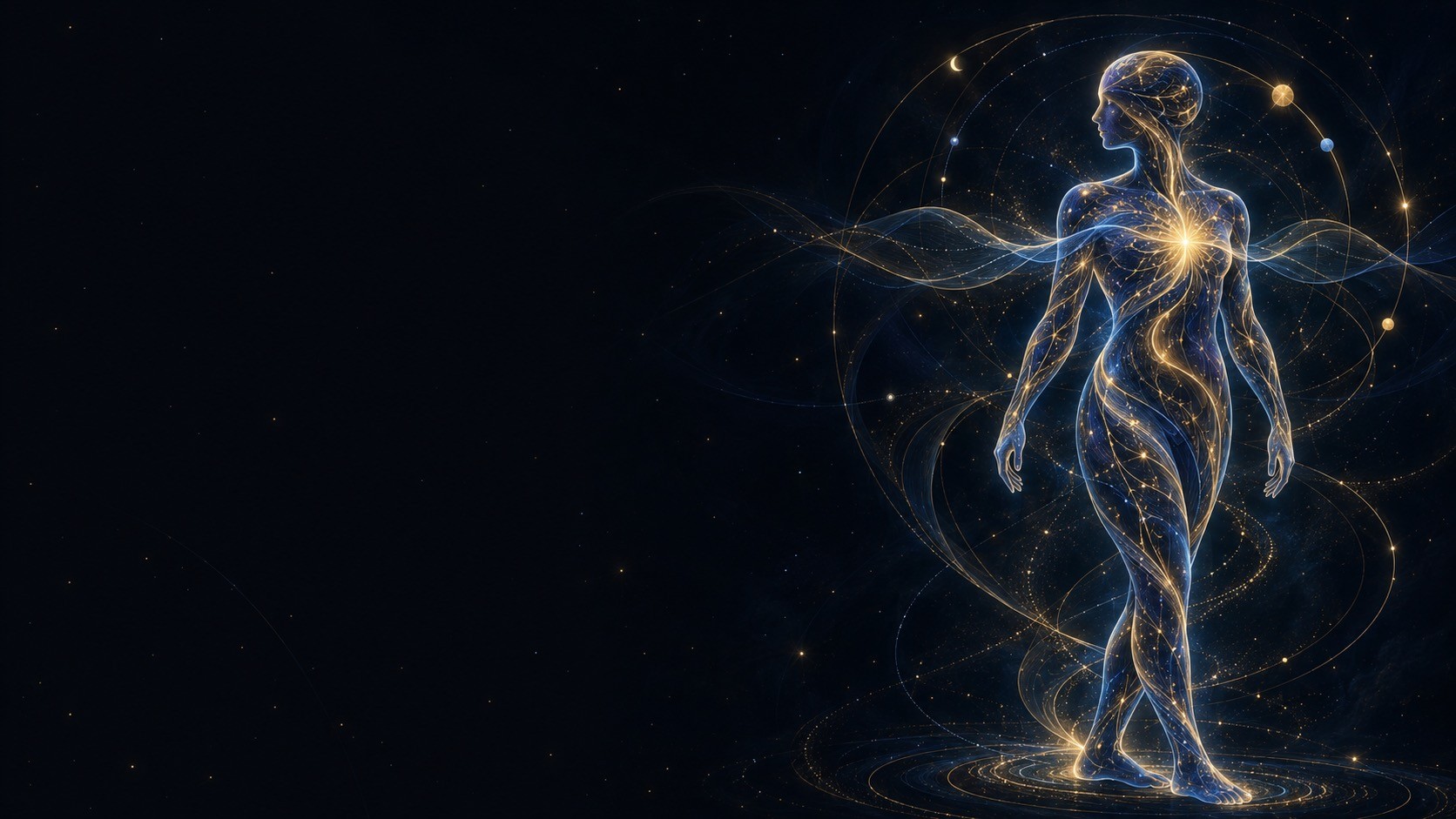
How It Works · An Education in Rhythm
At this moment, your body is running thousands of rhythms at once. Some tick in thousandths of a second. Some take years to turn over once.
You are not one clock. You are an ecosystem of clocks.
Touch a clock to light it on the figure. Heart, breath and stomach are moving at their real speed.
Right now, inside you
Your heart is beating. Your lungs are breathing. Your brain is cycling through electrical rhythms. Your stomach is producing slow waves. Your intestines are moving in longer housekeeping cycles.
Your hormones pulse by the minute, hour, day and month. Your immune system follows daily rhythms. Your cells pulse calcium, redox chemistry and gene expression.
Your skin renews over weeks. Your connective tissues remodel over months. Your bones may take months or years to complete structural change.
Milliseconds to seconds
Brain waves, nerves, reflexes, muscle recruitment, vision, proprioception, heartbeat.
Seconds to minutes
Respiration, heart-rate variability, blood-pressure regulation, vasomotion, lymphatic pumping, mitochondrial and calcium signalling.
Minutes to hours
Gut motility, insulin pulses, hormone release, autonomic switching, sleep stages, immune signalling.
Hours to days
Circadian rhythm, cortisol, melatonin, body temperature, immune-cell trafficking, inflammatory regulation, gene expression.
Weeks to years
Skin renewal, nerve recovery, muscle adaptation, fascia, tendon, cartilage, scar remodelling, bone remodelling and long-term structural change.
From milliseconds to years
Every clock below is placed where it actually runs. The scale jumps tenfold at each step, because nothing else fits a heartbeat and a bone on the same line.
Each bar spans the range of time over which that system characteristically runs. Choose one to read what it is doing.
On a small screen, swipe the ribbon sideways to travel through time.
The secret is not synchrony
Healthy physiology does not mean every oscillator runs at the same speed. That would be impossible.
Your heart and lungs do not run at the same frequency, but they influence one another. Your brain, spinal cord and proprioceptive system continuously exchange timing information to produce movement. Your circadian system coordinates sleep, temperature, hormones, metabolism and immune function. Your gut has its own nervous system, yet it stays in constant conversation with your brain and autonomic nervous system.
The better question may be less "Is every part working?" and more "Are the body's clocks communicating at the right time?"
Two clocks at different speeds, listening to each other. In a healthy resting body the heart quickens a little on each in-breath and eases on each out-breath: respiratory sinus arrhythmia. Switch the conversation off and the two simply run side by side.
One disruption can touch many systems
Because these systems are coupled, disruption in one regulatory loop can ripple through many others. Choose where the disruption enters.
This does not mean every symptom has one cause. It means the body is a network.
A few of your internal clocks
A lit dot is ticking at that clock's real tempo. The rest are too slow to watch. And even this is simplified: a single tissue can hold several clocks at once. Bone responds to mechanical signals almost instantly, uses cellular signalling over hours and days, and remodels its physical structure over months.
Why slow systems can be last to change
Fast signalling can change before structure does. So visible structural change can lag far behind the regulatory change that set it in motion.
This is one reason biological recovery is rarely a straight line. The body may change its instructions long before the physical architecture finishes carrying them out.
Illustrative. The same instruction, arriving at four timescales.
What if some chronic dysfunction involves not only damaged parts, but disrupted relationships between biological oscillators?
Instead of thinking only in terms of
the model asks whether recovery may sometimes involve
In this framework, a healthy system does not become synchronised to one external master frequency. It becomes better able to coordinate with itself. That distinction is fundamental.
Why multiple references might matter
Mirrorwave currently uses ten generators operating in parallel. The working model is not simply "ten times more signal."
It is that parallel substacks may provide several simultaneous reference possibilities, while the receiving organism determines what it can currently use, route and retain.
The long-term goal would not be permanent dependence on an external signal. The strongest theoretical endpoint is the opposite: internal organisation that remains stable after the external reference is no longer required.
An illustration of the hypothesis, not a measurement: ten references offered in parallel, only some taken up, a few settling into the body's own steady rhythm.
Think orchestra, not machine
A drum does not need to become a flute. The instruments remain different. What matters is whether they can hear one another well enough to play the same piece.
The heart keeps its rhythm. The gut keeps its rhythm. The brain keeps many rhythms. Hormones pulse on their own schedules. Bone takes its own sweet geological time.
Health may emerge not because every system becomes identical, but because different systems recover the ability to coordinate without losing their individuality.
The Mirrorwave principle
The body does not need one master frequency. It needs its many clocks to remember how to speak to one another.
Educational note. The physiological rhythms described on this page are established features of human biology. The Mirrorwave interpretation involving oscillator recoupling and distributed external reference signals is a working systems hypothesis and has not been established as a conventional medical mechanism. This page is educational and is not a medical diagnosis or treatment recommendation.